Key Takeaways
- Subscription-first architecture is essential for managing recurring payments, orders, and customer preferences.
- Core features should include subscription plans, recurring billing, order management, payments, notifications, and customer controls.
- Reliable integrations with payment, shipping, inventory, CRM, and analytics systems are critical for smooth operations.
- Development costs can range from $8,000 to $90,000+ depending on complexity, integrations, platforms, and scalability requirements.
- Retention management should focus on flexible subscriptions, customer feedback, renewal experience, and continuous product improvements.
Subscription-based e-commerce is changing how businesses sell products by turning one-time purchases into recurring customer relationships. Instead of asking customers to place a new order every time they need a product, subscription apps can automatically manage recurring orders, payments, deliveries, and account preferences.
This model is particularly useful for products purchased regularly, such as groceries, beauty products, pet supplies, wellness products, and household essentials. However, building a subscription e-commerce app requires more than adding a recurring payment option to a standard shopping application.
The app needs features for subscription plans, billing cycles, order scheduling, delivery management, renewals, cancellations, customer retention, and secure payment processing. Businesses also need a scalable backend that can manage recurring transactions and changing subscription preferences.
This guide explains how to build a subscription-based e-commerce app, covering its core features, development process, technology requirements, and estimated development cost. It also highlights the factors businesses should consider before investing in subscription e-commerce development.
Subscription Ecommerce App Development Market Statistics
The subscription e-commerce market size has grown exponentially in recent years. It will grow from $536.72 billion in 2025 to $859.52 billion in 2026 at a compound annual growth rate (CAGR) of 60.1%.
The global subscription e-commerce market size was valued at USD 2,719.54 billion in 2025 and is projected to grow from USD 3,088.71 billion in 2026 to USD 9,051.84 billion by 2034, exhibiting a CAGR of 14.40% during the forecast period.
The subscription e-commerce market size is expected to grow from USD 180.48 billion in 2025 to USD 206.26 billion in 2026 and is forecast to reach USD 402.2 billion by 2031 at a 14.28% CAGR over 2026-2031.
Subscription eCommerce Model: How It Works and Generates Recurring Revenue
A subscription e-commerce model allows customers to purchase products or services on a recurring schedule instead of placing individual orders. The customer typically selects a product, chooses a subscription plan, provides payment details, and sets the preferred delivery frequency.
A typical subscription journey works like this:
- Product Selection: Customers browse products and select the items they want to receive regularly.
- Plan Selection: They choose a billing or delivery frequency, such as weekly, monthly, or quarterly.
- Payment Setup: The customer adds a supported payment method and authorizes recurring charges.
- Order Scheduling: The system automatically creates upcoming orders based on the selected subscription cycle.
- Fulfillment: The business processes and ships each scheduled order.
- Subscription Management: Customers can pause, skip, modify, upgrade, downgrade, or cancel their subscription according to the available policies.
- Renewal: The payment system processes the next recurring charge, and the cycle continues.
Behind this experience, the application needs a subscription engine that tracks billing dates, product quantities, customer preferences, payment status, and upcoming orders. This makes subscription e-commerce more operationally complex than a standard shopping app.
What Makes a Subscription eCommerce App Different from Traditional Apps?
A standard e-commerce app is primarily designed around individual purchases, while a subscription-based app must continuously manage the customer relationship after the first transaction. This creates additional requirements across billing, orders, inventory, delivery, and account management.
Recurring Billing Instead of One-Time Payments
The payment system must support recurring charges based on the customer's selected plan. It should also handle failed payments, retries, refunds, renewals, and payment-method updates without requiring customers to repeat the checkout process.
Scheduled Orders and Deliveries
Subscription orders need to be generated automatically according to each customer's schedule. The system should account for delivery dates, product availability, order modifications, and fulfillment status.
Flexible Subscription Management
Customers expect control over their subscriptions. Features such as pause, skip, reschedule, change quantity, switch products, and cancel can make the experience more convenient and reduce unnecessary cancellations.
Retention-Focused Experience
Subscription businesses depend on repeat purchases, so the app needs more than a traditional checkout flow. Personalized recommendations, renewal reminders, loyalty benefits, discounts, and relevant notifications can encourage customers to continue their subscriptions.
Recurring Operations Behind the App
The backend must continuously track subscription status, billing cycles, upcoming orders, inventory requirements, and customer preferences. This means businesses need reliable automation and monitoring even when customers are not actively using the application.
For this reason, e-commerce app development for a subscription business should begin with the recurring customer journey rather than simply adapting a conventional shopping app. The architecture needs to support both the initial purchase and every subsequent subscription cycle.
Planning the App Around Seamless Subscription User Journeys
Before development begins, businesses should map how customers will discover products, start subscriptions, manage recurring orders, and eventually renew or cancel them. Designing around these journeys helps ensure that the app supports both customer expectations and backend operations.
Map the Customer Journey
Start by defining the steps from product discovery to subscription renewal. Consider how customers select plans, choose delivery preferences, make payments, receive reminders, and manage their subscriptions. Each stage should have a clear and simple user flow.
Define Subscription Rules
Determine the available billing cycles, pricing options, discounts, minimum commitments, renewal conditions, cancellation policies, and pause or skip rules. These decisions become part of the subscription engine and should be established before development begins.
Plan Business Operations
The app should also reflect how the business handles inventory, order processing, fulfillment, shipping, refunds, and customer support. Subscription orders need to be synchronized with these operations so recurring purchases do not create inventory or delivery problems.
Choose an MVP Scope
A minimum viable product can focus on essential capabilities such as product browsing, account creation, subscription plans, checkout, recurring payments, order tracking, and subscription management.
Consider Scalability From the Beginning
Subscription volumes can grow quickly when customers renew regularly. Businesses should therefore plan for increasing users, recurring transactions, product catalogs, and order volumes. Working with a D2C e-commerce development company can help businesses align the app's customer experience with direct-to-consumer operations and long-term growth requirements.
Essential Features Every Subscription eCommerce App Should Include
A subscription e-commerce app needs features that support the complete lifecycle of recurring purchases. Along with standard shopping capabilities, it should give customers control over their subscriptions and provide businesses with tools to manage recurring orders and revenue.
Customer-Facing Features
- Product Catalog: Customers can browse products, categories, pricing, availability, and product details.
- Subscription Plans: Users can choose different delivery frequencies, quantities, packages, or membership options.
- Recurring Checkout: A streamlined checkout flow should capture payment and subscription preferences in a single process.
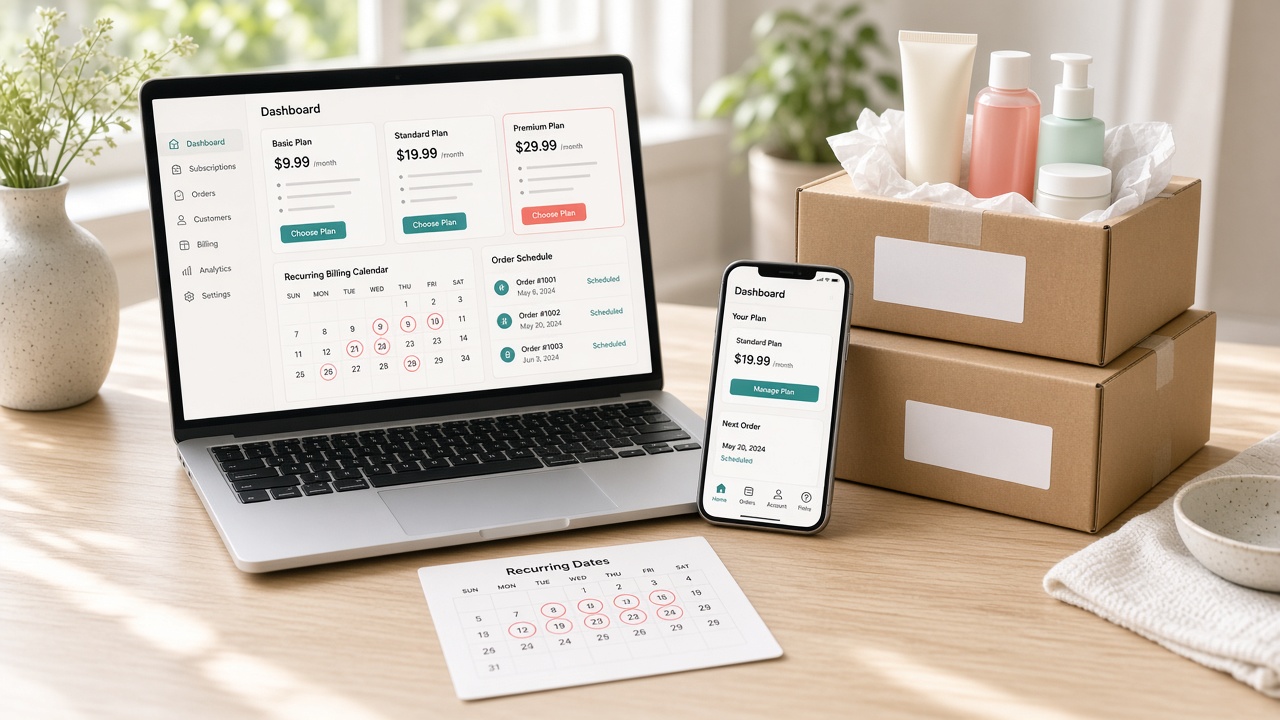
- Subscription Dashboard: Customers can view upcoming orders, billing dates, active plans, and subscription status.
- Pause, Skip, and Cancel: Users should be able to manage their subscriptions without contacting customer support for routine changes.
- Payment Management: Customers can add, update, or remove supported payment methods and view transaction history.
- Order Tracking: Users can monitor recurring orders from processing through delivery.
- Notifications: Reminders about upcoming charges, renewals, deliveries, failed payments, and subscription changes keep customers informed.
Business and Admin Features
- Subscription Management: Administrators can create plans, modify pricing, manage renewals, and review active subscriptions.
- Recurring Order Management: The system can automatically generate upcoming orders and send them to fulfillment.
- Inventory Management: Businesses can monitor stock requirements based on current and upcoming subscription orders.
- Customer Management: Admins can view customer profiles, subscription history, order activity, and support requests.
- Analytics Dashboard: Reports can track recurring revenue, active subscribers, cancellations, renewals, average order value, and customer retention.
- Promotions and Discounts: Businesses can create introductory offers, subscription discounts, coupons, and promotional campaigns.
Designing a Scalable Subscription and Billing Engine for eCommerce Apps
The subscription and billing engine is one of the most important parts of a recurring e-commerce application. It connects customer plans with payment schedules, order creation, renewals, and subscription status. If this layer is unreliable, even a well-designed customer app can create failed payments, duplicate orders, or missed deliveries.
Manage Subscription States
The system should track different subscription states, such as active, paused, past due, cancelled, expired, or pending. Every state should have clearly defined rules for what actions the customer and business can perform.
Automate Recurring Payments
The billing system should calculate upcoming charges and initiate payments according to the selected billing cycle. It should also handle failed transactions through retries, payment-method updates, and appropriate customer notifications.
Generate Recurring Orders
After a successful billing event, the system can automatically create the corresponding order. This order should be connected to the customer's subscription so that fulfillment teams can identify recurring purchases and upcoming demand.
Support Plan Changes
Customers may want to change quantities, products, delivery frequencies, or subscription tiers. The billing engine should calculate any applicable price differences and ensure changes take effect according to the business rules.
Handle Renewals, Refunds, and Cancellations
The system should maintain accurate renewal dates and process cancellations according to the selected policy. Refunds, partial refunds, failed renewals, and charge reversals should also be reflected in subscription and order records.
Keep Billing and Orders Synchronized
Payment status and order status should not operate independently. The application needs reliable event handling so that payment failures do not accidentally generate fulfillable orders and successful renewals are correctly reflected in upcoming deliveries.
Building the App: From MVP to a Full-Scale Subscription Product
A subscription e-commerce app is easier to manage when development is divided into clear stages. Instead of building every possible feature at launch, businesses can start with the core subscription journey and expand the product based on customer behavior and operational needs.
1. Define Requirements and User Flows
Document the target customers, products, subscription plans, payment rules, delivery model, and business processes. Create user flows for registration, product discovery, subscription checkout, recurring orders, account management, and cancellation.
2. Design the Customer and Admin Interfaces
Create wireframes and UI designs for both customer-facing screens and administrative dashboards. The design should make subscription details, upcoming charges, delivery dates, and account controls easy to understand.
3. Develop the Backend
Build the backend services responsible for users, products, subscriptions, orders, payments, inventory, notifications, and administrative operations. The subscription engine should be designed to handle recurring events reliably.
4. Build Customer Applications
Develop the web or mobile application that customers use to browse products, subscribe, manage plans, make payments, and track orders. A mobile app development company can help build native or cross-platform mobile experiences when mobile is a major part of the customer journey.
5. Integrate Payments and External Services
Connect payment gateways, shipping providers, notification services, analytics tools, and other required systems. Each integration should be tested for successful transactions as well as failures and interruptions.
6. Test the Complete Subscription Cycle
Test the application from initial subscription through recurring billing, order creation, fulfillment, renewal, plan changes, and cancellation. Security, performance, payment failures, and edge cases should also be evaluated.
7. Launch and Improve
Release the MVP to a controlled customer group before expanding. Monitor subscription conversions, failed payments, cancellations, recurring revenue, and user feedback. Additional features can then be introduced based on actual business requirements.
This staged approach keeps e-commerce software development services aligned with business priorities while providing a practical path from an initial MVP to a larger subscription platform.
Technology Stack and Price Considerations for Subscription Ecommerce Apps
The technology stack directly affects an app's performance, scalability, security, and development cost. A subscription e-commerce platform typically requires technologies for the customer interface, backend, database, payments, cloud infrastructure, and recurring billing.
| Technology Layer | Common Options | Purpose | Estimated Cost Contribution |
|---|---|---|---|
| Frontend | React, Next.js, Flutter, React Native | Builds web and mobile interfaces | $2,000–$8,000 |
| Backend | Node.js, Python, Java | Handles business logic, subscriptions, orders, and APIs | $3,000–$12,000 |
| Database | PostgreSQL, MySQL, MongoDB | Stores users, products, orders, and subscription data | $1,000–$4,000 |
| Payment Integration | Stripe, PayPal, Razorpay | Processes recurring and one-time payments | $800–$3,000 |
| Cloud Infrastructure | AWS, Azure, Google Cloud | Hosting, storage, scaling, and backups | $1,000–$5,000 |
| Notifications | Firebase, Twilio, email APIs | Sends payment, renewal, and delivery alerts | $500–$2,000 |
| Admin Dashboard | React, Angular, Vue | Manages products, subscriptions, orders, and customers | $1,500–$6,000 |
Integrating Payments, Shipping, and Business Systems
A subscription e-commerce app depends on several external systems to complete recurring purchases and fulfill customer orders. Reliable integrations ensure that a successful payment can trigger the correct order, inventory update, delivery process, and customer notification.
Payment Gateway Integration
Payment gateways handle recurring charges, payment authorization, refunds, and transaction status. The integration should support webhooks so the app can automatically respond when payments succeed, fail, or require additional action.
Shipping and Delivery Integration
Shipping APIs can connect the application with logistics providers and automate shipment creation, tracking updates, delivery estimates, and status notifications. This is particularly important for subscriptions because multiple future deliveries may need to be scheduled and tracked.
Inventory and Order Management
The subscription engine should communicate with inventory systems to determine whether products are available for upcoming recurring orders. This can help businesses identify potential shortages before an order is generated and allow customers to select alternative products when necessary.
CRM and Customer Support
CRM integration can give support teams access to subscription status, order history, payment events, and customer preferences. This allows representatives to resolve subscription issues without manually checking multiple systems.
Analytics and Marketing Tools
Analytics platforms can track subscription conversions, renewals, churn, customer acquisition, and revenue. Marketing integrations can also support personalized campaigns, renewal reminders, abandoned checkout messages, and re-engagement campaigns.
Why Integration Architecture Matters
As the number of integrations increases, businesses need a controlled backend layer rather than connecting every service directly to every other system. APIs, webhooks, queues, and integration services can help keep data synchronized and make individual services easier to replace or upgrade.
eCommerce App Development Cost and Timeline: Key Factors to Consider
The e-commerce app development cost for a subscription-based e-commerce app can vary significantly depending on the number of features, platforms, integrations, subscription complexity, and customization required. For a practical 2027 estimate, businesses can expect development costs to range from $8,000 to $90,000+.
| App Type | Estimated Cost | Development Timeline |
|---|---|---|
| Basic Subscription Ecommerce MVP | $8,000–$20,000 | 2–3 months |
| Mid-Level Subscription App | $20,000–$45,000 | 3–5 months |
| Advanced Subscription Platform | $45,000–$70,000 | 5–7 months |
| Enterprise Subscription Ecommerce App | $70,000–$90,000+ | 7–10+ months |
Key Factors That Can Increase eCommerce App Development Costs
Several factors can push subscription e-commerce development beyond the initial estimate:
- Complex subscription models: Multiple plans, billing cycles, upgrades, downgrades, trials, and usage-based pricing require more development work.
- Third-party integrations: Connecting payment gateways, shipping providers, CRM systems, inventory tools, and analytics platforms increases both development and testing requirements.
- Multiple platforms: Building separate web, Android, and iOS applications requires additional design, development, and maintenance.
- Advanced personalization: AI recommendations, predictive analytics, and personalized offers add complexity to the application.
- Security and scalability: Strong authentication, payment security, monitoring, backups, and infrastructure for high transaction volumes can increase costs.
Businesses can control expenses by prioritizing essential subscription features for the MVP and adding advanced capabilities after validating customer demand.
Managing the App Launch, Customer Retention, and Subscription Lifecycle
Launching a subscription e-commerce app is only the beginning. Businesses also need to continuously monitor subscriptions, customer behaviour, and recurring orders to maintain long-term engagement.
Start With a Controlled Launch
Begin with the core subscription journey and a limited customer group. Monitor payments, renewals, deliveries, cancellations, and customer support issues before expanding to a larger audience.
Make Subscription Management Easy
Customers should be able to pause, skip, change, or cancel subscriptions without unnecessary steps. Clear billing information and renewal reminders can also reduce confusion and support requests.
Track Retention Metrics
Businesses should monitor metrics such as subscription conversion, renewal rate, churn, average order value, and customer lifetime value. These insights can help identify where customers are leaving and which parts of the experience need improvement.
Improve Through Customer Feedback
Regularly review customer feedback and support requests to identify problems with pricing, product selection, delivery, or subscription flexibility. Continuous improvements can make the app more useful as the subscriber base grows.
Conclusion
Building a subscription-based e-commerce app requires more than adding recurring payments to a traditional shopping platform. Businesses need a reliable subscription engine, flexible customer controls, secure payment processing, and integrations that connect orders, inventory, shipping, and customer management.
A phased development approach can help businesses launch an MVP, validate the subscription model, and gradually introduce advanced features. With the right technology architecture and development strategy, a subscription e-commerce app can support recurring revenue while creating a more convenient purchasing experience for customers.
Frequently Asked Questions
1. How much does it cost to build a subscription e-commerce app?
A subscription e-commerce app can cost around $8,000–$90,000+, depending on features, platforms, integrations, and complexity.
2. How long does it take to develop a subscription e-commerce app?
Development can take approximately 2–10+ months, depending on the application's scope and complexity.
3. What is the most important feature of a subscription e-commerce app?
A reliable subscription and billing system is essential for managing recurring payments, renewals, orders, and subscription changes.
4. Can customers pause or skip their subscriptions?
Yes. Pause, skip, resume, upgrade, downgrade, and cancellation options can be included in the subscription management system.
5. Which payment gateways can support recurring payments?
Platforms such as Stripe, PayPal, and Razorpay can support recurring payment workflows, depending on the region and specific business requirements.
6. Should a subscription e-commerce app have a mobile version?
A mobile application can improve accessibility and make subscription management, notifications, and repeat purchases more convenient for customers.
7. Can subscription e-commerce apps integrate with inventory systems?
Yes. Inventory integration can help synchronize stock levels with upcoming recurring orders and reduce fulfillment issues.