Key Takeaways
- B2B eCommerce development typically costs $5,000 to $60,000+, depending on complexity, integrations, and customization.
- B2B platforms need customer-specific pricing, bulk ordering, quotations, approvals, and company accounts — not a standard B2C storefront.
- ERP, CRM, payment, shipping, and warehouse integrations are often essential for accurate pricing and inventory.
- A typical project takes around 3 to 8 months, with several stages running in parallel.
- A structured process from requirement analysis through maintenance reduces operational risk after launch.
B2B commerce has moved far beyond phone calls, spreadsheets, printed catalogs, and manually processed purchase orders. Manufacturers, wholesalers, distributors, suppliers, and enterprise sellers increasingly need digital platforms where business buyers can discover products, negotiate pricing, place bulk orders, manage accounts, and track purchases without relying on lengthy offline processes.
This shift has made B2B eCommerce development an important investment for companies looking to automate sales, improve buyer experiences, reduce operational workload, and expand into new markets.
Unlike traditional B2C stores, B2B platforms must handle complex requirements such as customer-specific pricing, bulk ordering, quotation workflows, purchase approvals, multiple users under a single business account, ERP integrations, credit limits, and recurring orders.
Building such a platform therefore requires more than creating an online storefront.
This guide explains B2B eCommerce development, its essential features, technology stack, estimated cost, development process, timeline, and the major factors businesses should consider before starting a project.
What Is B2B eCommerce Development?
B2B eCommerce development is the process of designing and building digital commerce platforms that allow one business to sell products or services directly to other businesses.
Instead of targeting individual consumers, these platforms are created for professional buyers such as retailers, distributors, wholesalers, procurement teams, franchise operators, corporate customers, and institutional purchasers.
A B2B eCommerce solution can take different forms, including:
- Wholesale eCommerce websites
- Manufacturer ordering portals
- Distributor platforms
- Supplier marketplaces
- Dealer portals
- Procurement platforms
- B2B mobile applications
- Multi-vendor B2B marketplaces
- Enterprise commerce platforms
- Customer self-service portals
Businesses planning both desktop and mobile purchasing experiences may also consider eCommerce app development alongside their web platform to give regular buyers faster access to ordering, account management, notifications, and repeat purchasing.
How Is B2B eCommerce Different From B2C eCommerce?
B2C eCommerce generally focuses on short buying journeys where an individual discovers a product, adds it to a cart, pays, and receives the order.
B2B purchasing is usually more complicated.
A single transaction may involve procurement managers, department heads, finance teams, account managers, suppliers, and approval workflows.
B2B platforms therefore need to accommodate different commercial rules.
For example, two companies purchasing the same product may receive entirely different prices based on negotiated contracts, order quantities, location, purchasing history, or customer tier.
Common differences include:
| B2B eCommerce | B2C eCommerce |
|---|---|
| Bulk purchases | Individual purchases |
| Negotiated pricing | Standard pricing |
| Quote requests | Direct checkout |
| Multiple account users | Individual accounts |
| Purchase approvals | Immediate buying decisions |
| Credit terms | Upfront payment |
| Repeat orders | Occasional purchases |
| ERP and CRM integrations | Simpler integrations |
| Complex product catalogs | Consumer friendly catalogs |
| Long term buyer relationships | Transaction focused relationships |
Understanding these differences is essential before choosing features or architecture for a B2B platform.
Essential Features of a B2B eCommerce Platform
A successful B2B platform needs features that make complicated business transactions easier to manage.
1. Business Account Management
B2B customers should be able to create company accounts rather than simple individual customer profiles.
One organization may have multiple users with different roles, including:
- Administrator
- Procurement manager
- Buyer
- Finance manager
- Branch manager
- Approver
Role based access allows businesses to control which employees can browse products, place orders, approve purchases, access invoices, or manage account information.
2. Customer Specific Pricing
Personalized pricing is one of the most important B2B eCommerce features.
Businesses may offer different prices depending on:
- Customer contracts
- Purchase volume
- Membership level
- Geographic region
- Distributor tier
- Order history
- Negotiated agreements
The platform should automatically display the correct price after the customer logs in.
3. Bulk Ordering
Business buyers often purchase hundreds or thousands of units at once.
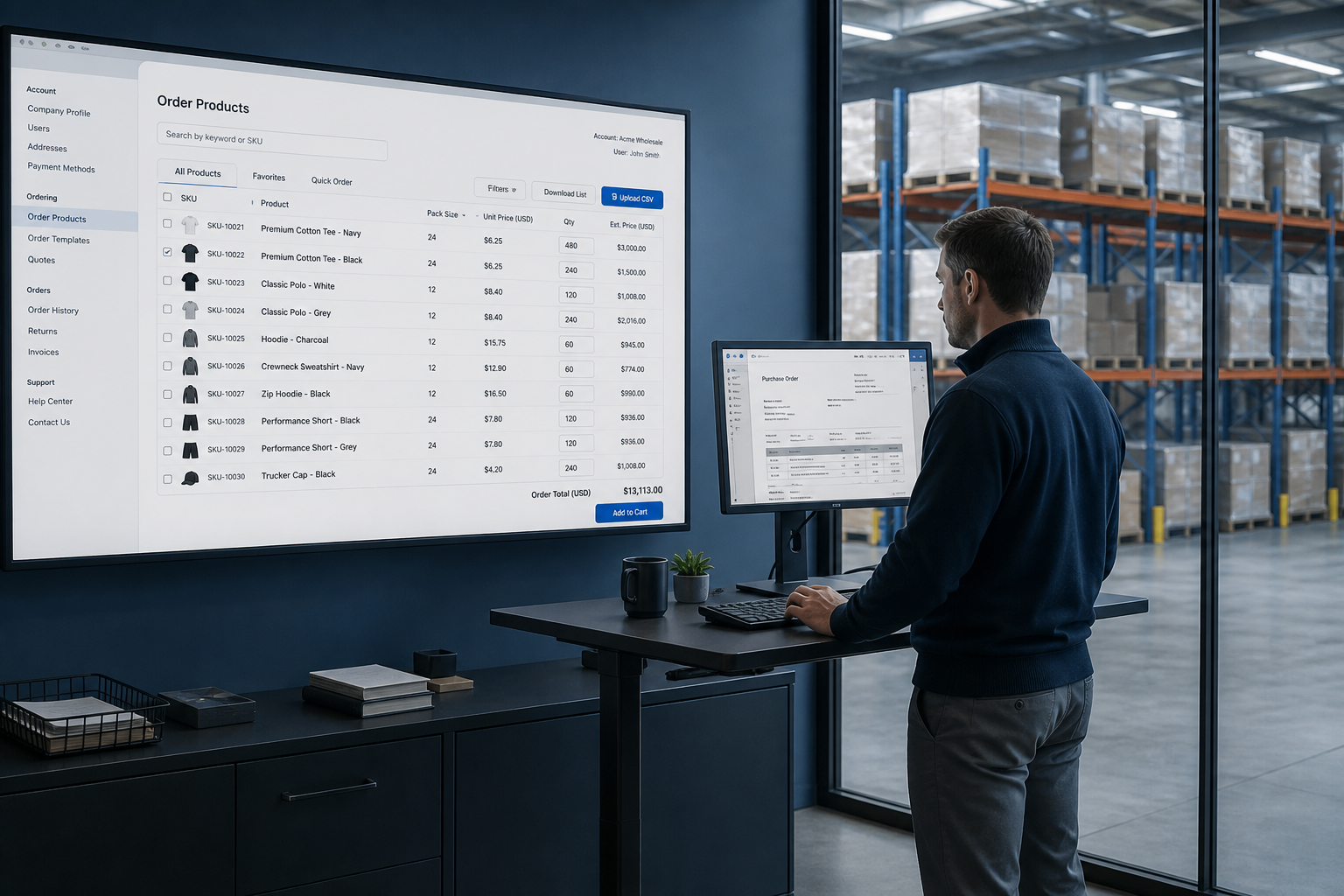
Instead of adding products individually, buyers should be able to enter SKUs, select quantities, upload CSV files, or reorder previous purchases.
Quick order functionality can significantly shorten the purchasing process for frequent customers.
4. Request for Quote
Not every B2B transaction has a fixed price.
An RFQ feature allows buyers to submit product quantities and requirements before requesting customized pricing.
Sales teams can review the request, negotiate terms, generate a quotation, and allow the customer to convert the accepted quote directly into an order.
5. Minimum Order Quantity
Manufacturers and wholesalers frequently establish minimum order quantities.
The platform can automatically enforce rules such as:
- Minimum number of units
- Minimum order value
- Product specific quantities
- Carton quantities
- Pallet quantities
- Customer specific requirements
This reduces the need for manual order verification.
6. Tiered and Volume Pricing
Volume based pricing encourages buyers to purchase larger quantities.
For example:
- 100 units: $20 each
- 500 units: $18 each
- 1,000 units: $15 each
The system can automatically calculate applicable discounts based on quantities selected by the buyer.
7. Advanced Product Catalog
B2B catalogs can contain thousands or even millions of products.
A powerful catalog system should support categories, attributes, variations, SKUs, technical specifications, downloadable documents, compatibility information, and multiple price structures.
Businesses that need a broader understanding of building scalable online storefronts can also explore eCommerce website development, particularly when planning catalog architecture, navigation, checkout, and backend infrastructure.
8. Advanced Search and Filtering
Business buyers often know precisely what they need.
The platform should allow them to search using:
- Product names
- SKU numbers
- Manufacturer codes
- Categories
- Specifications
- Brands
- Availability
- Price
- Product attributes
Intelligent search can make extremely large product catalogs easier to navigate.
9. Purchase Order Management
Many companies use purchase orders rather than immediate card payments.
A B2B eCommerce system can allow customers to enter PO numbers, upload purchase order documents, track approvals, and associate invoices with individual transactions.
10. Multiple Payment Options
B2B payment requirements differ significantly between customers.
Payment options may include:
- Credit and debit cards
- Bank transfers
- ACH payments
- Digital wallets
- Purchase orders
- Corporate accounts
- Credit terms
- Net 30, Net 60, or Net 90 payments
Payment methods may also vary depending on customer contracts.
11. Credit Limit Management
Approved customers may receive predefined credit limits.
The platform can track available credit, outstanding invoices, payment history, and overdue balances before allowing additional purchases.
12. Order Approval Workflows
Large organizations may require purchases to be approved before orders are submitted.
For example: Buyer creates order → Department manager approves → Finance approves → Order is processed
Approval rules may depend on the total purchase value, department, product category, or employee permissions.
13. Repeat and Recurring Orders
B2B customers frequently order the same products.
Features such as one click reordering, saved shopping lists, recurring purchases, and order templates can significantly reduce the time required to complete repeat transactions.
14. Real Time Inventory
Displaying accurate stock information helps business buyers plan purchases effectively.
Inventory systems can show:
- Available quantities
- Warehouse availability
- Expected restock dates
- Backorder status
- Reserved quantities
Connecting the platform with ERP or warehouse management software can keep information synchronized.
15. Invoice Management
Customers should be able to access invoices directly through their account dashboards.
Features may include invoice downloads, payment status, outstanding balances, credit notes, tax information, and transaction histories.
Important Integrations for B2B eCommerce Development
B2B platforms rarely operate independently.
They typically connect with several business systems.
ERP Integration
ERP integration synchronizes important information such as:
- Inventory
- Orders
- Product information
- Customer records
- Pricing
- Accounting
- Invoices
- Fulfillment
Platforms may integrate with systems such as SAP, Microsoft Dynamics, Oracle, NetSuite, or other enterprise software.
CRM Integration
Connecting a CRM helps sales teams maintain a unified view of customers and purchasing activities.
CRM systems can track leads, buyers, communication, purchase history, quotations, and customer relationships.
Payment Gateway Integration
Secure payment gateways allow businesses to process transactions using different payment methods.
B2B systems may require more advanced payment logic because certain customers may use cards while others receive invoice or credit based payment terms.
Shipping and Logistics Integration
Shipping integrations can calculate freight costs, generate labels, provide estimated delivery times, and allow customers to track shipments.
For large B2B orders, freight and logistics requirements may be considerably more complex than standard parcel delivery.
Accounting Software Integration
Integrations with accounting platforms can synchronize invoices, transactions, taxes, payments, refunds, and financial records.
Warehouse Management Integration
Connecting a warehouse management system allows real time coordination between inventory, fulfillment, packing, and shipping operations.
Technology Stack for B2B eCommerce Development
Selecting the right technology stack affects performance, scalability, security, integration flexibility, and long term maintenance.
Frontend Technologies
Common technologies include:
- React.js
- Next.js
- Angular
- Vue.js
- HTML5
- CSS3
- JavaScript
- TypeScript
Modern frontend frameworks make it possible to create fast, responsive, and interactive buyer experiences.
Backend Technologies
Common backend options include:
- Node.js
- Laravel
- PHP
- Python
- Django
- Java
- .NET
- Ruby on Rails
The backend manages product information, customers, business rules, orders, pricing, integrations, payments, and administrative operations.
Database Technologies
Common databases include:
- MySQL
- PostgreSQL
- MongoDB
- Microsoft SQL Server
- Redis
Database selection depends on product catalog size, transaction volume, architecture, and scalability requirements.
Cloud Infrastructure
Cloud platforms can help businesses scale their B2B commerce infrastructure.
Popular options include:
- Amazon Web Services
- Microsoft Azure
- Google Cloud Platform
Cloud infrastructure can support automatic scaling, backups, monitoring, storage, content delivery, and disaster recovery.
eCommerce Platforms
Depending on business requirements, companies can develop B2B systems using:
- Shopify Plus
- Adobe Commerce
- BigCommerce
- WooCommerce
- Salesforce Commerce Cloud
- Custom commerce architecture
A custom solution may be preferable where existing platforms cannot support specialized pricing, workflows, integrations, or business models.
B2B eCommerce Development Process
Building a B2B platform requires careful planning because mistakes in pricing, inventory, integrations, or order workflows can directly affect business operations.
Step 1: Business Requirement Analysis
Development begins by understanding the company's existing sales processes.
Important questions include:
- Who are the buyers?
- How are orders currently placed?
- Does every customer receive different pricing?
- Are purchase approvals required?
- Which payment terms are supported?
- Which existing systems need integration?
- How many products will the platform manage?
Answers to these questions define the scope of the project.
Step 2: Feature Planning
The next stage involves creating a detailed list of platform capabilities.
Features should normally be divided into essential and future requirements.
An MVP may initially include customer accounts, catalogs, pricing, bulk orders, checkout, payments, and basic administration.
Advanced functionality can be introduced gradually.
Step 3: UI and UX Design
Designers create user flows, wireframes, prototypes, and interfaces.
B2B UX should prioritize efficiency rather than unnecessary complexity.
Returning customers should be able to reorder products, find SKUs, check prices, view invoices, and manage purchases quickly.
Step 4: Architecture and Technology Selection
Developers determine:
- Frontend framework
- Backend technology
- Database structure
- Hosting infrastructure
- API architecture
- Security requirements
- Third party integrations
Choosing scalable architecture at this stage can prevent expensive redevelopment later.
Step 5: Frontend Development
Developers build interfaces including:
- Homepage
- Catalog
- Product pages
- Search
- Customer dashboard
- Cart
- Quote management
- Checkout
- Order history
- Account settings
Responsive design ensures that buyers can access the platform across desktop, tablet, and mobile devices.
Step 6: Backend Development
Backend development implements core B2B commerce functionality.
This includes authentication, pricing rules, order processing, inventory, quotations, payments, business accounts, user permissions, and administrative controls.
Step 7: Third Party Integrations
ERP, CRM, payment, shipping, accounting, marketing, and inventory systems are connected through APIs or middleware.
Integration testing is especially important because inconsistent data can cause incorrect pricing or inventory information.
Step 8: Quality Assurance
Testing should cover:
- Functionality
- Performance
- Security
- Compatibility
- Usability
- Payments
- Pricing rules
- APIs
- Order workflows
- User permissions
- Integrations
B2B systems should also be tested under realistic transaction volumes.
Step 9: Deployment
Once testing is complete, the platform is deployed to production infrastructure.
Data such as products, customer accounts, prices, order histories, and inventory may also need to be migrated from older systems.
Step 10: Maintenance and Optimization
Development does not end after launch.
Businesses should continuously monitor platform performance, security, conversions, user behavior, integrations, and operational efficiency.
Future versions can introduce automation, personalization, AI features, and additional integrations.
How Much Does B2B eCommerce Development Cost?
The cost of B2B eCommerce development can typically range from approximately $5,000 to $60,000 or more, depending on project complexity.
A relatively straightforward wholesale portal costs considerably less than an enterprise platform containing complex pricing engines, large catalogs, ERP integrations, multiple warehouses, custom approval workflows, and advanced automation.
Estimated B2B eCommerce Development Cost
| Project Type | Estimated Cost |
|---|---|
| Basic B2B eCommerce Website | $5,000 to $12,000 |
| Custom B2B Commerce Platform | $12,000 to $30,000 |
| Advanced B2B Marketplace | $25,000 to $45,000 |
| Enterprise B2B eCommerce Platform | $40,000 to $60,000+ |
These figures are estimates rather than fixed prices.
Businesses focused specifically on storefront budgeting can read the detailed guide to eCommerce website development cost, while companies planning a companion mobile experience can review eCommerce app development cost separately.
Factors Affecting B2B eCommerce Development Cost
Several factors determine the final budget.
Platform Complexity
A standard wholesale portal is easier to develop than a multi-vendor enterprise marketplace.
Increasing business logic increases both development and testing requirements.
Number of Features
Features such as quotation systems, multi-level approvals, recurring orders, advanced dashboards, credit management, and personalized pricing increase development effort.
Custom UI and UX
Using highly customized interfaces generally requires more design and frontend development than adapting a standard template.
Third Party Integrations
ERP, CRM, accounting, shipping, inventory, and payment integrations can significantly affect the cost.
Legacy systems may require custom middleware or APIs.
Product Catalog Size
Managing several hundred products is different from supporting millions of SKUs across multiple categories, warehouses, and price structures.
Security Requirements
Enterprise commerce platforms may require advanced authentication, access controls, monitoring, encryption, audit trails, and compliance measures.
Mobile Application
Developing dedicated iOS and Android apps increases the overall investment compared with creating only a responsive B2B website.
Development Team
Project cost also depends on the location, experience, engagement model, and technical capabilities of the development company.
How Long Does B2B eCommerce Development Take?
A typical B2B eCommerce project can take approximately 3 to 8 months, although enterprise platforms may require longer.
An approximate timeline may look like this:
| Development Stage | Estimated Time |
|---|---|
| Research and Planning | 1 to 3 weeks |
| UI and UX Design | 2 to 5 weeks |
| Frontend Development | 4 to 8 weeks |
| Backend Development | 6 to 12 weeks |
| Integrations | 3 to 8 weeks |
| Testing and QA | 2 to 5 weeks |
| Deployment | 1 to 2 weeks |
Several stages can run simultaneously, so the total project duration is not simply the sum of every individual phase.
Benefits of B2B eCommerce Development
A properly developed B2B platform can improve both sales and internal operations.
24/7 Ordering
Customers can place orders without waiting for sales representatives or business hours.
Reduced Manual Work
Automating quotations, orders, invoices, payments, and inventory updates reduces administrative workload.
Faster Ordering
Saved orders, product lists, bulk ordering, and quick reorder features make repeat purchases significantly easier.
Greater Sales Reach
Digital commerce allows wholesalers and manufacturers to serve customers across new regions without establishing physical sales operations everywhere.
Better Customer Experience
Customers gain self-service access to pricing, products, invoices, orders, shipments, and account information.
Accurate Business Data
Integrated systems can create more consistent information across sales, inventory, finance, and fulfillment departments.
Improved Scalability
Automation allows businesses to process higher order volumes without increasing manual operations at the same rate.
Emerging Trends in B2B eCommerce
B2B commerce continues to become more sophisticated as buyer expectations change.
Artificial Intelligence
AI can support product recommendations, intelligent search, demand forecasting, customer service, fraud detection, and sales automation.
Headless Commerce
Headless architecture separates the commerce backend from customer-facing interfaces.
This gives businesses greater flexibility when delivering experiences across websites, applications, portals, kiosks, and other digital channels.
Self-Service Buying
Business buyers increasingly expect to manage orders, accounts, quotations, payments, and invoices without contacting sales representatives for every transaction.
Omnichannel Commerce
B2B customers may interact with a company through websites, apps, sales teams, marketplaces, physical branches, and customer portals.
Connecting these channels can create a more consistent purchasing experience.
Personalized B2B Experiences
Modern B2B systems can personalize catalogs, pricing, promotions, payment terms, and recommendations for individual organizations.
Mobile B2B Commerce
Procurement teams and business owners increasingly perform purchasing activities on mobile devices.
Mobile friendly platforms and dedicated applications can make account management and repeat ordering more convenient.
How to Choose a B2B eCommerce Development Company?
The right development partner should understand both software development and the complexity of B2B commerce.
Before selecting a company, evaluate its experience with:
- Custom eCommerce architecture
- B2B workflows
- ERP and CRM integration
- Payment systems
- Large product catalogs
- Cloud infrastructure
- Security
- API development
- Mobile commerce
- Performance optimization
The company should also understand your existing sales processes before recommending technology.
A successful B2B platform should support the way your business actually operates rather than forcing complex operations into a generic eCommerce template.
Conclusion
B2B eCommerce development enables manufacturers, wholesalers, suppliers, distributors, and enterprise sellers to transform traditional sales processes into scalable digital commerce experiences.
However, a B2B platform requires considerably more than a standard shopping cart.
Features such as customer specific pricing, bulk ordering, quotations, purchase approvals, company accounts, credit management, recurring orders, ERP integration, and advanced inventory management are often essential for supporting real business transactions.
The overall B2B eCommerce development cost can range from approximately $5,000 to $60,000+, depending on platform complexity, features, integrations, technology, security requirements, and customization.
By carefully defining requirements, selecting scalable technology, prioritizing essential features, and following a structured development process, businesses can create B2B commerce platforms that simplify purchasing, automate operations, improve customer relationships, and support long term growth.
Frequently Asked Questions
1. What is B2B eCommerce development?
B2B eCommerce development involves creating digital platforms that allow businesses to sell products or services directly to other businesses online.
2. How much does B2B eCommerce development cost?
B2B eCommerce development may cost approximately $5,000 to $60,000+, depending on features, integrations, platform complexity, design, and technology requirements.
3. How long does it take to build a B2B eCommerce platform?
A typical B2B eCommerce platform may require around 3 to 8 months, while highly customized enterprise projects can require additional development time.
4. What features should a B2B eCommerce platform include?
Important features include business accounts, custom pricing, bulk ordering, quotations, approval workflows, credit management, invoicing, inventory, payments, and ERP integration.
5. Which technology is best for B2B eCommerce development?
The best technology depends on project requirements. Common options include React, Next.js, Node.js, Laravel, Python, .NET, Shopify Plus, Adobe Commerce, and custom architectures.
6. Why do businesses need B2B eCommerce platforms?
B2B platforms automate purchasing, reduce manual work, provide 24/7 ordering, improve customer self-service, increase operational efficiency, and support scalable business growth.